Noche Potosi

Noche Potosi
Iglesia San Bernardo

miércoles, 9 de octubre de 2019

NOBEL PRIZE The most important award for Science and Technology

 Fuente: 

https://es.wikipedia.org/wiki/Premio_Nobel

  Premio Nobel


Premio Nobel
NobelP2.png
Premio Nobel
Nombre originalNobelpriset (en sueco)
Premio aReconocimiento a una contribución excepcional en los estudios de Física, Química, Fisiología o Medicina, Literatura, Paz y Economía (y otros equivalentes) .
Otorgado porReal Academia Sueca de Ciencias
Instituto Karolinska
Academia Sueca
Comité Noruego del Nobel
UbicaciónBandera de Suecia Estocolmo, Suecia
Bandera de Noruega Oslo, Noruega
Historia
Inspirado porAlfred Nobel
Primera entrega1901
Destacado
FísicaGanadores
QuímicaGanadores
Fisiología o MedicinaGanadores
LiteraturaGanadores
PazGanadores
EconomíaGanadores
Sitio oficial
El Premio Nobel (pronunciado /nobél/, aunque está muy extendida la pronunciación llana /nóbel/;1​ en sueco, Nobelpriset;2​ en noruego, Nobelprisen)3​ es un galardón internacional que se otorga cada año para reconocer a personas o instituciones que hayan llevado a cabo investigaciones, descubrimientos o contribuciones notables a la humanidad en el año anterior o en el transcurso de sus actividades.4
Los premios se instituyeron en 1895 como última voluntad de Alfred Nobel, industrial sueco,4​ y comenzaron a entregarse en 1901 en las categorías de Física, Química, Fisiología o Medicina, Literatura y Paz.5
A partir de 1968 se estableció también el Premio del Banco de Suecia en Ciencias Económicas en memoria de Alfred Nobel gestionado por la Real Academia de las Ciencias de Suecia y que es mal llamado Premio Nobel de Economía.5
Ante la inexistencia del Premio Nobel de Ciencias Matemáticas, Sophus Lie fue el primero en proponer la creación del Premio Abel cuando en 1897 se enteró de que Alfred Nobel no tuvo la intención de crear un premio de Matemática, el Premio Abel es otorgado por la Academia Noruega de Ciencias y Letras en honor al matemático noruego al que debe su nombre. De igual manera en 1933 se instauró la Medalla Fields, cuyo galardón ostentaba la Medalla Internacional para Descubrimientos Sobresalientes en Matemáticas, en honor al matemático canadiense al que debe su nombre.

Constituye el mayor reconocimiento a los científicos : PREMIO NOBEL DE FISICA, PREMIO NOBEL DE QUIMICA Y PREMIO NOBEL DE FISIOLOGIA Y MEDICINA, también se otorgan premios Nobel en Economía, Paz y Literatura).
La totalidad de lo que queda de mi fortuna quedará dispuesta del modo siguiente: el capital, invertido en valores seguros por mis testamentarios, constituirá un fondo cuyo interés será distribuido cada año en forma de premios entre aquellos que durante el año precedente hayan realizado el mayor beneficio a la humanidad. Dicho interés se dividirá en cinco partes iguales, que serán repartidas de la siguiente manera: una parte a la persona que haya hecho el descubrimiento o el invento más importante dentro del campo de la física; una parte a la persona que haya realizado el descubrimiento o mejora más importante dentro de la química; una parte a la persona que haya hecho el descubrimiento más importante dentro del campo de la fisiología o la medicina; una parte a la persona que haya producido la obra más sobresaliente de tendencia idealista dentro del campo de la literatura, y una parte a la persona que haya trabajado más o mejor en favor de la fraternidad entre las naciones, la abolición o reducción de los ejércitos existentes y para la celebración y promoción de congresos por la paz. Los premios para la física y la química serán otorgados por la Academia Sueca de las Ciencias, el de fisiología y medicina será concedido por el Instituto Karolinska de Estocolmo; el de literatura, por la Academia de Estocolmo, y el de los defensores de la paz, por un comité formado por cinco personas elegidas por el Storting noruego. Es mi expreso deseo que, al otorgar estos premios, no se tenga en consideración la nacionalidad de los candidatos, sino que sean los más merecedores los que reciban el premio, sean escandinavos o no.
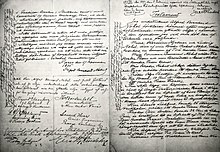
Fragmento del testamento de Alfred Nobel [«Alfred Nobel's last will and testament» (en inglés). The Local. Consultado el 25 de junio de 2014.]
No se otorga premio nobel en Matemáticas pese a su indiscutible importancia fundamental en la Física y Química , en cambio se ha establecido la MEDALLA FIELDS (CADA CUATRO AÑOS)


la tabla siguiente fue colocada el 18 de enero de 2019.
Se deben agregar  :
En Física : Estados Unidos  1
   Suiza    1

En Química:  Estados Unidos 2
Japón 1
En Medicina y Fisiología: Estados Unidos 2
Reino Unido 2 
con premios en 2019.
(El premio Nobel de Física , Suiza y Reino Unido)
Estados Unidos  377+5 = 382
Reino Unido  130 +2 = 132
Suiza 26 + 2 = 28
Japón 27 +1 = 28

The following table was taken from


Número de laureados de los Premios Nobel por país
País Cantidad de laureados
Bandera de Estados Unidos Estados Unidos 377
Bandera de Reino Unido Reino Unido 130
Bandera de Alemania Alemania 108
Bandera de Francia Francia 69
Bandera de Suecia Suecia 32
Bandera de Japón Japón 27
Bandera de Canadá Canadá 26
Bandera de Suiza Suiza 26
Bandera de Rusia Rusia 25
Bandera de Austria Austria 21
Bandera de los Países Bajos Países Bajos 21
Bandera de Italia Italia 20
Bandera de Polonia Polonia 14
Bandera de Dinamarca Dinamarca 13
Bandera de Hungría Hungría 13
Bandera de Noruega Noruega 13
Bandera de Australia Australia 12
Bandera de Israel Israel 12
Bandera de Bélgica Bélgica 11
Bandera de India India 10
Bandera de Sudáfrica Sudáfrica 10
Bandera de la República Popular China China 8
Bandera de Irlanda Irlanda 8
Bandera de España España 8
Bandera de Argentina Argentina 5
Bandera de República Checa República Checa 5
Bandera de Finlandia Finlandia 5
Bandera de Ucrania Ucrania 5
Bandera de Egipto Egipto 4
Bandera de Rumania Rumania 4
Bandera de Lituania Lituania 3
Bandera de México México 3
Bandera de Nueva Zelanda Nueva Zelanda 3
Bandera de Argelia Argelia 2
Bandera de Bielorrusia Bielorrusia 2
Bandera de Bosnia y Herzegovina Bosnia y Herzegovina 2
Bandera de Chile Chile 2
Bandera de Colombia Colombia 2
Bandera de Timor Oriental Timor Oriental 2
Bandera de Grecia Grecia 2
Bandera de Guatemala Guatemala 2
Bandera de Liberia Liberia 2
Bandera de Luxemburgo Luxemburgo 2
Bandera de Pakistán Pakistán 2
Bandera de Portugal Portugal 2
Bandera de Santa Lucía Santa Lucía 2
Bandera de Turquía Turquía 2
Bandera de Azerbaiyán Azerbaiyán 1
Bandera de Bangladés Bangladés 1
Bandera de Brasil Brasil 1
Bandera de Bulgaria Bulgaria 1
Bandera de República Democrática del Congo República Democrática del Congo 1
Bandera de Costa Rica Costa Rica 1
Bandera de Croacia Croacia 1
Bandera de Chipre Chipre 1
Bandera de Islas Feroe Islas Feroe 1
Bandera de Ghana Ghana 1
Bandera de Hong Kong Hong Kong 1
Bandera de Islandia Islandia 1
Bandera de Irak Irak 1
Bandera de Irán Irán 1
Bandera de Kenia Kenia 1
Bandera de Yemen Yemen 1
Bandera de Letonia Letonia 1
Bandera de Macedonia del Norte Macedonia del Norte 1
Bandera de Marruecos Marruecos 1
Bandera de Birmania Birmania 1
Bandera de Nigeria Nigeria 1
Bandera de Palestina Palestina 1
Bandera del Perú Perú 1
Bandera de Serbia Serbia 1
Bandera de Eslovenia Eslovenia 1
Bandera de Taiwán Taiwán 1
Flag of Tibet.svg Tíbet 1
Bandera de Trinidad y Tobago Trinidad y Tobago 1
Bandera de Túnez Túnez 1
Bandera de Venezuela Venezuela 1
Bandera de Vietnam Vietnam 1
Bandera de Corea del Sur Corea del Sur 1


EL SIGUIENTE COMENTARIO PERTENECE AL AUTOR DEL BLOG:

Se debe destacar  Argentina , que recibio  5 (cinco ) premios nobel 

de los cuales:

 En ciencias básicas y Medicina:

Dos (2)  por MEDICINA [ Bernardo Houssay, 1947]; [ César Milstein, 1984],

Uno (1)  por QUÍMICA[ Luis Federico Leloir, 1970].

¡Pero , lamentablemente  al gran escritor argentino JORGE LUIS BORGES en Literatura, no se le concedió el premio,  que muchísimos:! ¡Consideramos  muy merecido!

Otros países sudamericanos:

Venezuela un (1) premio  por Medicina  [Baruj Ernesto Benacerraf] compartido con [ Jean Dausset y George D. Snell] ;  Brasil (uno) por MEDICINA [Peter Medawar] compartido con [Frank Macfarlane Burnet], 1960.

 De tal manera que en ciencias básicas Química; Medicina y Fisiología , Sud América contribuyó  con (5) científicos.


Largest lithium reserve on Planet Earth


LA MAYOR RESERVA DE LITIO DEL MUNDO.
TODO LO SIGUIENTE, Texto e imagenes han sido copiadas de : 
https://es.wikipedia.org/wiki/Salar_de_Uyuni

El salar de Uyuni es el mayor desierto de sal continuo y alto del mundo, con una superficie de 10 582 km² (o 4085 millas cuadradas).1​ Está situado a unos 3650 msnm en el suroeste de Bolivia, en la provincia de Daniel Campos, en el departamento de Potosí, dentro de la región altiplánica de la cordillera de los Andes. El salar de Uyuni es la mayor reserva de litio en el mundo con el 50-70 % del litio mundial, e igualmente cuenta con importantes cantidades de potasio, boro y magnesio.2​^[Bolivia Destinos (2011). «Salar de Uyuni». Archivado desde el original el 11 de octubre de 2012. Consultado el 22 de noviembre de 2011.]


Salar de Uyuni ubicada en BoliviaUyuni landsat.JPG

  Imagen 1:     Uyuni landsat      

         Imagen 1;                                                                                Imagen  2:

       Imagen 2      (no pertenece al autor de este blog)

PaísFlag of Bolivia.svg Bolivia
DivisiónFlag of Potosí.svg Potosí
Sub-divisiónDaniel Campos
Coordenadas20°08′02″S 67°29′21″OCoordenadas: 20°08′02″S 67°29′21″O (mapa)
Superficie10 582 km²
Altitud3663 msnm
Espesor máx.130 m
AfluentesRío Grande de Lípez
Desagüesevaporación


Formación

El área que hoy ocupa este desierto estaba cubierta hace 40 000 años por el lago Minchinnota 1​ y posteriormente, hace 11 000 años, por el lago Tauca o Tauka.nota 2​ En este período una fase de clima húmedo, con más lluvias que actualmente, estos protolagos alcanzaban una cota de alrededor de 100 m por encima del nivel actual. Posteriormente vino un periodo seco y cálido, que produjo una gran reducción de la superficie y volumen de los lagos andinos, originando así los salares de Uyuni y Coipasa además de las lagunas actuales. Los lagos Poopó y Uru Uru también son vestigios de estos grandes lagos prehistóricos.


 Volcán Tunupa

Por : Jduranboger - Trabajo propio (ESTA FOTOGRAFIA HA SIDO TOMADA DE WIKIPEDIA, NO ES PROPIA DEL AUTOR DE ESTE BLOG)

 CC BY-SA3.0


PREMIO NOBEL DE FISICA 2019

Por sus descubrimientos de exoplanetas ( planetas fuera del sistema solar, probablemente podría haber vida pero están muy distantes.
"El exoplaneta terrestre más cercano a la Tierra, Próxima b, descubierto en 2016, está a 4,5 años luz"


The next is from:

MLA style: The Nobel Prize in Physics 2019. NobelPrize.org. Nobel Media AB 2019. Wed. 9 Oct 2019.
<https//www.nobelprize.org/prizes/ physics/2019/summary/>

The Nobel Prize in Physics 2019 was awarded "for contributions to our understanding of the evolution of the universe and Earth's place in the cosmos" with one half to James Peebles "for theoretical discoveries in physical cosmology", the other half jointly to Michel Mayor and Didier Queloz

James Peebles
The Nobel Prize in Physics 2019
Born: 1935, Winnipeg, Canada
Affiliation at the time of the award: Princeton University, Princeton, NJ, USA
Prize motivation: "for theoretical discoveries in physical cosmology."
oz "for the discovery of an exoplanet orbiting a solar-type star."

Michel Mayor
The Nobel Prize in Physics 2019
Born: 1942, Lausanne, Switzerland
Affiliation at the time of the award: University of Geneva, Geneva, Switzerland
Prize motivation: "for the discovery of an exoplanet orbiting a solar-type star."


Didier Queloz
The Nobel Prize in Physics 2019
Born: 1966
Affiliation at the time of the award: University of Geneva, Geneva, Switzerland, University of Cambridge, Cambridge, United Kingdom
Prize motivation: "for the discovery of an exoplanet orbiting a solar-type star."

Rechargeable lithium ion battery (Bateria recargable de Ion Litio)

 Rechargeable lithium ion battery (BATERIA RECARGABLE  DE ION LITIO   

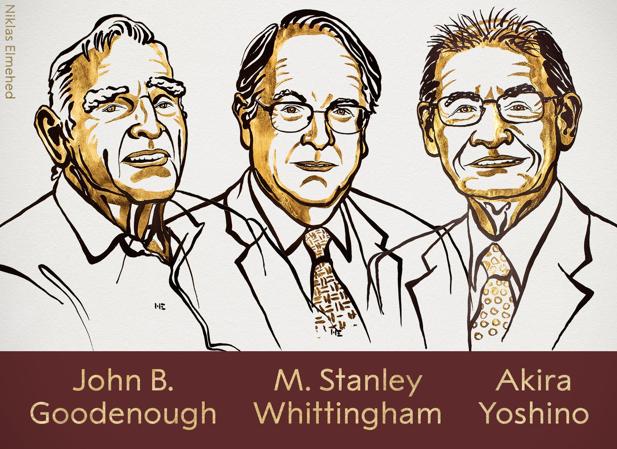
JOHN GOODENOUGH: The fundamental and basic idea


STANLEY WITTINGHAM :Development and improvement,  and  Akira Yoshino contribution to production.

CONFERENCIA DE PRENSA ANUNCIANDO LOS NOMBRES DE LOS GANADORES DEL PREMIO NOBEL DE QUIMICA 2019
Links :

https://www.nobelprize.org/

https://www.youtube.com/watch?time_continue=22&v=rgdDPHh_5es

 This Entry was take from above cited links.


THE NEXT , from:
ABC CIENCIA , España.


https://www.abc.es/ciencia/abci-nobel-quimica-2019-john-goodenough-stanley-wittingham-y-akira-yoshino-ganan-nobel-quimica-2019-201910091149_noticia.html


Nobel de Química 2019Nobel de Química para los «padres» de la batería del móvil

John B. Goodenough, Stanley Wittingham y Akira Yoshino desarrollaron las baterías recargables de iones de litio, hoy presentes en casi todos los dispositivos

Judith de Jorge
Judith de Jorge
 MadridActualizado:


M. Stanley Whittingham


From Wikipedia, the free encyclopedia
Jump to navigation Jump to search
Stanley Whittingham
Born
Michael Stanley Whittingham

1941 (age 77–78)
EducationNew College, Oxford (BA, MA, DPhil)
Known forLithium-ion battery
AwardsNobel Prize in Chemistry (2019)
Scientific career
FieldsChemist
InstitutionsBinghamton University
M. Stanley Whittingham (born 1941) is an English chemist. He is currently a professor of chemistry and director of both the Institute for Materials Research and the Materials Science and Engineering program at Binghamton University, part of the State University of New York. He was awarded the Nobel Prize in Chemistry in 2019.[1][2]
Whittingham is a key figure in the history of the development of lithium batteries, discovering the concept of intercalation electrodes.

 From: Wikipedia, The free encyclopedia:

Education and career

Whittingham was educated at Stamford School in Lincolnshire from 1951-1960, before going to New College, Oxford to read Chemistry. At the University of Oxford, he took his BA (1964), MA (1967), and DPhil (1968).[3] After completing his graduate studies, Whittingham was a postdoctoral fellow at Stanford University until 1972. He then worked for Exxon Research & Engineering Company from 1972 until 1984. He then spent four years working for Schlumberger prior to becoming a professor at Binghamton University.[3]
For five years, he served as the University's vice provost for research and outreach.[citation needed] He also served as Vice-Chair of the Research Foundation of the State University of New York for six years. He is currently a Distinguished Professor of Chemistry and Materials Science and Engineering at Binghamton University.[citation needed]

Patents

  • 5,514,490 Secondary lithium battery using a new layered anode material
  • 4,339,424 Method of preparing W or Mo metal oxides
  • 4,243,624 Method of making cathodes derived from ammonium-metal-chalcogen compounds
  • 4,233,375 High energy density plural chalcogenide cathode-containing cell
  • 4,201,839 Cell containing an alkali metal anode, a solid cathode, and a closoborane and/or closocarborane electrolyte
  • 4,166,160 Cells having cathodes derived from ammonium-molybdenum-chalcogen compounds
  • 4,144,384 Cells having cathodes with vanadium-chalcogen-containing compounds
  • 4,143,213 Cells having cathodes containing chalcogenide compounds of the formula M.sub.a FeX.sub.b and species thereof exhibiting alkali metal incorporation
  • 4,139,682 Cells having cathodes derived from ammonium-copper-molybdenum-chalcogen compounds
  • 4,086,403 Alkali metal/niobium triselenide cell having a dioxolane-based electrolyte
  • 4,084,046 Rechargeable electrochemical cell with cathode of stoichiometric titanium disulfide
  • 4,049,887 Electrochemical cells with cathode-active materials of layered compounds
  • 4,049,879 Intercalated transition metal phosphorus trisulfides
  • 4,040,917 Preparation of intercalated chalcogenides
  • 4,009,052 Chalcogenide battery
  • 4,007,055 Preparation of stoichiometric titanium disulfide

Books

  • J. B. Goodenough & M. S. Whittingham (1977). Solid State Chemistry of Energy Conversion and Storage. American Chemical Society Symposium Series #163. ISBN 978-0-8412-0358-7.
  • G. G. Libowitz & M. S. Whittingham (1979). Materials Science in Energy Technology. Academic Press. ISBN 978-0-12-447550-2.
  • M. S. Whittingham & A. J. Jacobson (1984). Intercalation Chemistry. Academic Press. ISBN 978-0-12-747380-2.
  • D. L. Nelson, M. S. Whittingham and T. F. George (1987). Chemistry of High Temperature Superconductors. American Chemical Society Symposium Series #352. ISBN 978-0-8412-1431-6.
  • M. A. Alario-Franco, M. Greenblatt, G. Rohrer and M. S. Whittingham (2003). Solid-state chemistry of inorganic materials IV. Materials Research Society. ISBN 978-1-55899-692-2.

Most-cited papers

Following is a short list of some of his most cited papers.[3]

References


 https://en.wikipedia.org/wiki/M._Stanley_Whittingham

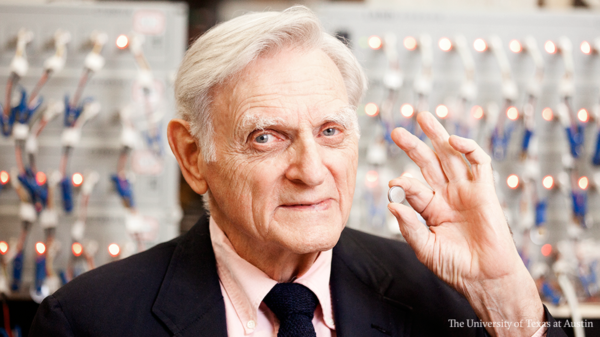
John B. Goodenough (de la Universidad de Texas en Austin)

Premio Novel de Química 2019

UT NEWS 

https://news.utexas.edu/2019/10/09/nobel-prize-in-chemistry-goes-to-john-goodenough-of-the-university-of-texas-at-austin/

Nobel Prize in Chemistry Goes to John Goodenough of The University of Texas at Austin

 Goodenough_John_battery-WM-COPYRIGHT-MARC-BROWN

"AUSTIN, Texas — John B. Goodenough, professor in the Cockrell School of Engineering at The University of Texas at Austin, has been awarded the 2019 Nobel Prize in chemistry — jointly with Stanley Whittingham of the State University of New York at Binghamton and Akira Yoshino of Meijo University — “for the development of lithium-ion batteries.”

"In the words of the Nobel Foundation, “Through their work, they have created the right conditions for a wireless and fossil fuel-free society, and so brought the greatest benefit to humankind.”
Goodenough, who was born in 1922, identified and developed the critical materials that provided the high-energy density needed to power portable electronics, initiating the wireless revolution. Today, batteries incorporating Goodenough’s cathode materials are used worldwide for mobile phones, power tools, laptops, tablets and other wireless devices, as well as electric and hybrid vehicles.
“Billions of people around the world benefit every day from John’s innovations,” said Gregory L. Fenves, president of The University of Texas at Austin and former dean of the Cockrell School. “In addition to being a world-class inventor, he’s an outstanding teacher, mentor and researcher. We are grateful for John’s three decades of contributions to UT Austin’s mission.”
“Live to 97 (years old) and you can do anything,” said Goodenough. “I’m honored and humbled to win the Nobel prize. I thank all my friends for the support and assistance throughout my life.”
In 1979, Goodenough showed that by using lithium cobalt oxide as the cathode of a lithium-ion rechargeable battery, it would be possible to achieve a high density of stored energy with an anode other than metallic lithium. This discovery led to the development of carbon-rich materials that allow for the use of stable and manageable negative electrodes in lithium-ion batteries.
“Professor John Goodenough is an extraordinary man and engineer, and I am delighted that his world-changing work is being recognized with the Nobel Prize,” said Cockrell School Dean Sharon L. Wood. “Today, everyone in the Texas Engineering community — our faculty, staff, students and alumni around the world — are proud of his accomplishment and inspired by the example he has set.”
"Goodenough began his career at the Massachusetts Institute of Technology’s Lincoln Laboratory in 1952, where he laid the groundwork for the development of random-access memory (RAM) for the digital computer. After leaving MIT, he became professor and head of the Inorganic Chemistry Laboratory at the University of Oxford. During this time, Goodenough made the lithium-ion discovery.

 (This copy of UT News not include a Photography of Dr. Goodenough at OXFORD, in 1982)

"After retiring from Oxford in 1986, Goodenough joined UT Austin, where he serves as the Virginia H. Cockrell Centennial Chair of Engineering in the Cockrell School. He holds faculty positions in the Walker Department of Mechanical Engineering and the Department of Electrical and Computer Engineering.
"At 97 years old, Goodenough continues to push the boundaries of materials science with the goal of inventing more sustainable and energy-efficient battery materials. Goodenough and his team recently identified a new safe cathode material for use in sodium-ion batteries.
Goodenough received a bachelor’s degree in mathematics from Yale University in 1944 and holds a doctorate in physics from the University of Chicago. He is the recipient of numerous national and international honors, including the Japan Prize, the Enrico Fermi Award, the Charles Stark Draper Prize and the National Medal of Science.
"Goodenough joins physicist Steven Weinberg as one of two current Nobel laureates at UT Austin. Weinberg won the prize in 1979 for contributions to the theory of the unified weak and electromagnetic interaction between elementary particles. Two other UT Austin professors, both now deceased, also won Nobel Prizes: Hermann J. Muller in medicine and physiology (1946) and Ilya Prigogine in chemistry (1977). Alumnus J.M. Coetzee won the Nobel Prize in literature (2003). Two UT Austin alumni have also won Nobel Prizes during the past two years, Michael Young and Jim Allison, who respectively won the prize for medicine or physiology in 2017 and 2018.
The Nobels are considered to be among the most prestigious prizes in the world and have been awarded for achievements in physics, chemistry, physiology or medicine, and literature by the Nobel Foundation in Stockholm, Sweden since 1901. The Nobel Peace Prize is awarded by the Norwegian Nobel Committee. Goodenough will receive a medal, cash prize and diploma at a ceremony in Stockholm in December.
"Correction: An earlier draft of this story was corrected to reflect that the Norwegian Nobel Committee awards the Nobel Peace Prize.

https://news.utexas.edu/tag/cockrell-school-of-engineering/